27
Nov
2026
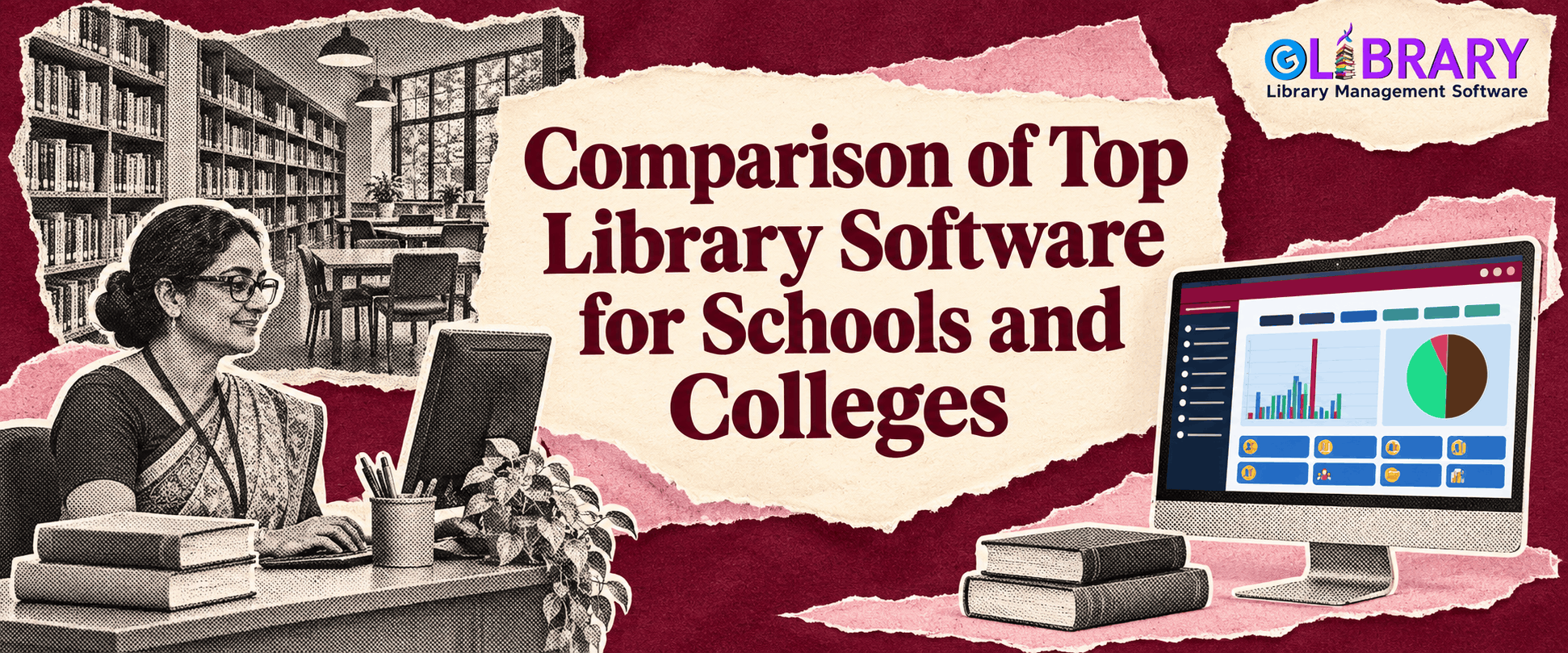
Comparison of Top Library Software for Schools and Colleges
Managing a school or college library involves much more than maintaining a collection of books. Librarians need to organize book records, manage student memberships, track book circulation, handle returns, maintain fines, and provide quick access to library resources. As educational institutions grow, handling these activities manually can become time-consuming.
This is why many institutions are adopting Library Management Software to simplify daily operations and improve the library experience. However, choosing the right system can be challenging because different platforms offer different features, technologies, and levels of customization.
In this article, we compare some popular library management solutions, including GLibrary, Koha, and e-Granthalaya, to help schools and colleges understand which option may suit their requirements.
1. GLibrary – Library Management Software for Educational Institutions
GLibrary is a library management solution designed for schools, colleges, universities, and other organizations. It brings several essential library operations together, helping librarians manage collections, circulation, members, and reports through a digital system.
Its feature set covers many of the everyday requirements of an academic library, making it an option worth considering for institutions looking for a dedicated library management platform.
Key features:
- Book and periodical management
- Circulation management for issue, reissue, and return
- Acquisition management
- Barcode generation and scanning
- Bulk uploading of book and member records
- OPAC (Online Public Access Catalogue)
- Fine collection and overdue management
- Multi-user login with role-based permissions
- Reporting and analytics
- Mobile app access
- Multiple language support
- RFID integration
What makes it useful?
GLibrary brings essential library activities into one system rather than requiring staff to manage each task separately. Bulk uploading can help when institutions need to add large numbers of book or member records. Barcode facilities can make circulation more efficient, while multi-user access allows authorized staff members to work with the system according to their permissions.
The availability of a mobile app also gives users another way to access library-related services.
Best suited for: Schools, colleges, and institutions looking for a dedicated platform to manage book collections, circulation, memberships, and routine library administration.
2. Koha – Open-Source Integrated Library System
Koha is a widely used open-source Integrated Library System (ILS). It is developed and maintained by an international community and supports libraries ranging from smaller collections to large academic institutions.
One of Koha's major advantages is its extensive functionality and the flexibility that comes with open-source software.
Key features:
- Cataloguing and acquisitions
- Circulation and patron management
- Serials management
- OPAC
- Customizable reports
- Barcode and label printing
- Multi-branch library support
- Offline circulation
- Support for library standards such as MARC 21
What makes it different?
Koha offers extensive control over library workflows and can be adapted to different institutional requirements. Since it is open source, institutions can work with their own technical teams or service providers for installation, customization, hosting, and ongoing maintenance.
However, being open source does not necessarily mean that the complete implementation is cost-free. Institutions should consider hosting, technical support, customization, upgrades, and staff training.
Best suited for: Colleges, universities, and institutions that need extensive library functionality and have access to technical expertise or implementation support.
3. LIBSYS Neo – Library Services and Automation Platform
LIBSYS Neo is a library management platform developed by LIBSYS. It is designed for academic institutions, universities, research organizations, and other libraries that require advanced automation and resource management.
It focuses on bringing library operations and resource discovery together, with additional capabilities for digital resources and integrations.
Key features:
- Acquisition and cataloguing
- Circulation management
- OPAC and discovery services
- Electronic resource management
- RFID integration
- Analytics and reporting
- Mobile-friendly access
- Integration with third-party systems
- Communication through email, SMS, and other channels
What makes it different?
LIBSYS Neo offers a broader library services platform approach. In addition to traditional book management, its ecosystem includes discovery, electronic resource management, remote access, and RFID-related solutions.
This can be useful for institutions managing a combination of physical and digital resources. However, institutions should evaluate which modules they actually need, the implementation requirements, and the overall cost.
Best suited for: Universities, research institutions, and larger academic libraries looking for advanced automation and integrated resource services.
4. e-Granthalaya – Government Library Automation Platform
e-Granthalaya is developed by the National Informatics Centre (NIC), under the Ministry of Electronics and Information Technology, Government of India. It is designed primarily for government libraries and supports library automation, digital library services, and resource sharing.
Its fourth version provides a cloud-ready, web-based platform with a centralized database option for groups of libraries.
Key features:
- Book acquisition and cataloguing
- Circulation management
- OPAC
- Digital library integration
- Serials management
- Library statistics and reports
- Barcode and RFID-related integration
- Multi-library and centralized database capabilities
- Member services and resource sharing
What makes it different?
e-Granthalaya has a strong focus on government library workflows and networking between libraries. Its digital library module and centralized database capabilities can be useful for organizations managing multiple libraries.
However, its intended use and implementation arrangements should be considered carefully by private schools and colleges before selecting it.
Best suited for: Government and semi-government libraries, public institutions, and library networks that require centralized administration.
5. NewGenLib – Integrated Library Management System
NewGenLib is another library automation system that has been used by academic and other institutional libraries. It supports common library activities, including organizing collections and managing circulation.
Institutions considering NewGenLib should review the available version, technical requirements, implementation support, and compatibility with their existing infrastructure.
Key capabilities to evaluate:
- Bibliographic database management
- Cataloguing and circulation
- Member records
- OPAC and catalogue searching
- Reports and library administration
- Support for library automation workflows
What makes it different?
NewGenLib is an option for institutions exploring alternatives to commercial library platforms. Its suitability depends on the institution's required features, the available implementation resources, and the level of ongoing support it can obtain.
Before deployment, schools and colleges should arrange a practical demonstration and verify the software's current maintenance and support arrangements.
Best suited for: Academic and institutional libraries evaluating alternative library automation systems and willing to assess their technical and support requirements.
Quick Comparison of Top Library Management Software
| Software | Main Strength | Suitable For |
|---|---|---|
| GLibrary | Core library operations, barcode facilities, bulk uploading, OPAC, mobile app | Schools and colleges |
| Koha | Open-source flexibility and extensive library modules | Colleges and universities |
| LIBSYS Neo | Advanced automation, discovery, RFID, and digital resource services | Universities and research libraries |
| e-Granthalaya | Government library automation and centralized management | Government libraries |
| NewGenLib | Library automation and essential library workflows | Academic and institutional libraries |
Note: This is a general feature and suitability comparison, not a performance ranking. Actual capabilities, implementation requirements, and available modules may vary by version and deployment.
How to Choose the Right Library Management System?
Before selecting software, schools and colleges should evaluate more than the number of features listed on a website. Consider the following points:
1. Understand your library's requirements
Identify whether you primarily need book cataloguing, circulation, membership management, digital resources, or multi-branch administration.
2. Check ease of use
Librarians should be able to perform everyday activities without complicated procedures. Ask for a live demonstration of book issue, return, member registration, and report generation.
3. Evaluate barcode and RFID support
Barcode scanning can simplify circulation, while RFID can support more advanced identification and security workflows. Select the technology that matches your library's needs and budget.
4. Review reporting capabilities
Useful reports help administrators understand book availability, circulation activity, overdue records, and collection usage.
5. Consider implementation and support
Check the installation or hosting requirements, data migration process, staff training, customer support, backup arrangements, and ongoing costs.
There is no single library management solution that is ideal for every educational institution. Koha offers open-source flexibility, while e-Granthalaya provides a platform focused on government library automation and networking. GLibrary brings together essential library management capabilities, including circulation, cataloging, OPAC, barcode support, member management, and mobile access.
The right choice depends on the institution's requirements, technical resources, budget, and long-term plans. Schools and colleges should compare available features, request demonstrations, and evaluate the actual workflow before selecting their Library Management Software.
A well-chosen system can help librarians reduce repetitive administrative work, maintain accurate records, and provide students with a more organized library experience.