27
Nov
2026
Manual vs Digital Library Management: Why Glibrary Wins
Libraries play an important role in schools, colleges, universities, and other educational institutions. Managing books, memberships, circulation, attendance, and records efficiently is essential for providing a smooth library experience. However, many libraries still depend on traditional manual methods, such as registers, spreadsheets, and paper-based records, to handle their daily activities.
While manual management may work for smaller libraries, it becomes increasingly difficult as the number of books, students, and daily transactions grows. This is why many educational institutions are moving towards digital solutions.
A modern Library Management Software helps automate routine activities, reduce paperwork, and make library administration more organized. But how different is digital library management from traditional methods, and why is it becoming the preferred choice? Let's explore.
1. Manual Library Management: How Does It Work?
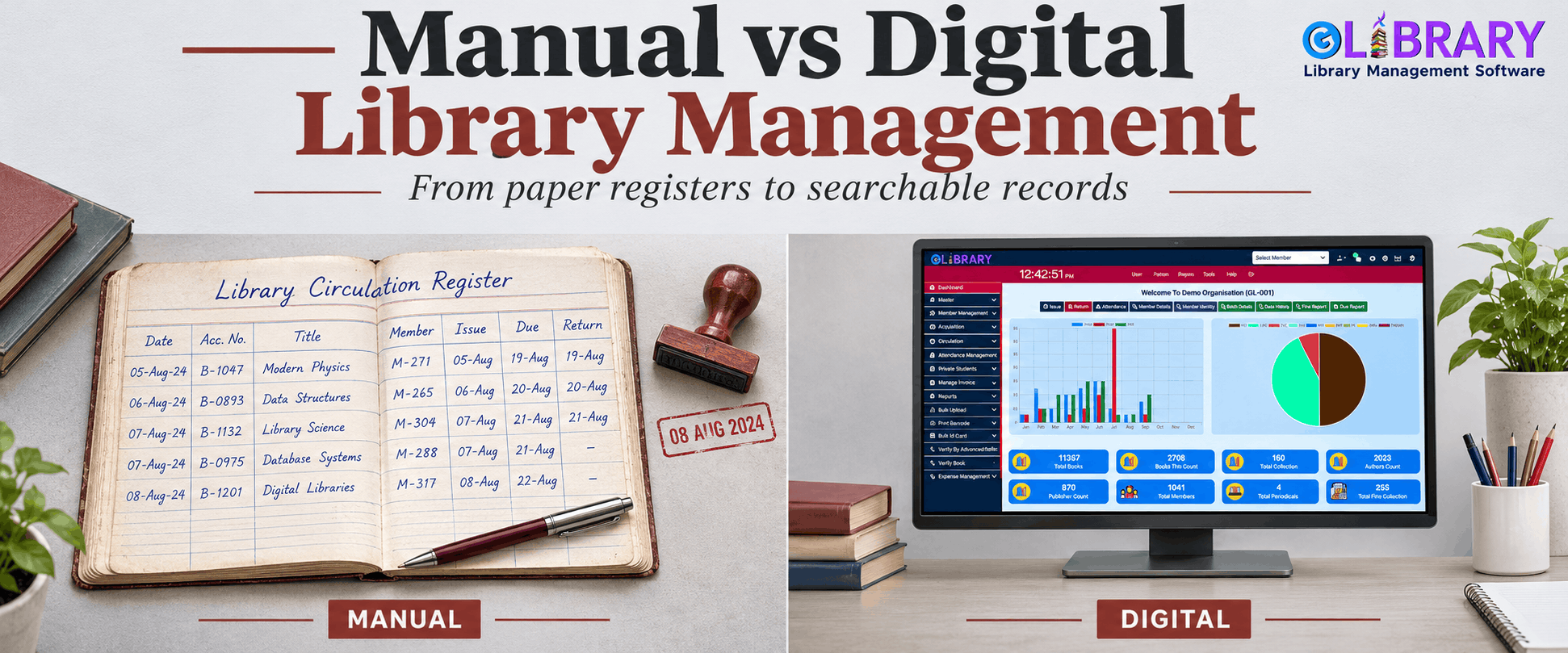
Traditional library management involves maintaining physical registers and manually recording important information. Librarians use notebooks, spreadsheets, and paper files to manage book inventories, student details, book issuing, returns, and fines.
For example, whenever a student borrows a book, the librarian manually records the student's details, book information, issue date, and return date.
Although this process is straightforward, it creates several challenges:
- Maintaining large volumes of paperwork.
- Difficulty finding specific book or member records.
- Increased chances of human errors.
- Time-consuming book issuing and return procedures.
- Difficulty tracking overdue books.
- Complicated report preparation.
As a library grows, maintaining accurate records through manual processes becomes increasingly challenging.
2. Digital Library Management: A Smarter Approach
Digital library management replaces traditional paperwork with centralized software that helps administrators manage library operations electronically.
A Library Management System Software allows librarians to maintain book catalogs, student records, circulation details, membership information, and reports through a single platform.
Instead of searching through multiple registers, administrators can access the required information digitally.
A modern Library Management Application can also support barcode scanning, RFID integration, online catalogs, and automated notifications, depending on the available features.
This approach saves administrative time and makes library operations more efficient.
3. Manual vs Digital Library Management: Key Differences
Let's compare both approaches across important library activities.
A. Book Inventory Management
Manual Management: Librarians maintain book details in registers or spreadsheets. Finding a particular book or checking its availability may require searching through multiple records.
Digital Management: Library software allows administrators to organize books using details such as title, author, ISBN, category, and publication information. Searching and updating records becomes much easier.
B. Book Issuing and Returns
Manual Management: Every issue and return transaction must be entered manually. Missing entries or incorrect dates can create confusion.
Digital Management: A digital system maintains borrowing records, issue dates, return dates, and member details. Barcode and RFID integration can make these processes faster.
C. Student and Member Management
Manual Management: Maintaining student details, membership information, and borrowing histories requires separate registers or files.
Digital Management: A Library Management Software solution stores member information centrally, making it easier to update records, check membership status, and review borrowing history.
D. Fine and Payment Management
Manual Management: Librarians calculate overdue fines manually and maintain payment records separately, increasing the possibility of calculation errors.
Digital Management: Software can calculate fines based on predefined rules and maintain digital payment records, reducing repetitive administrative work.
E. Reports and Analysis
Manual Management: Preparing reports about issued books, overdue items, popular titles, and membership activity can take considerable time.
Digital Management: Reports can be generated from stored records, helping administrators understand library performance and make informed decisions.
4. Why Are Educational Institutions Switching to Digital Library Management?
Schools, colleges, and universities handle large collections of books and student records. Managing everything manually can affect productivity and create unnecessary administrative pressure.
Here are some important reasons behind the shift towards digital library systems.
Time Savings: Automated processes reduce repetitive tasks and allow librarians to focus on helping students and managing resources.
Better Accuracy: Digital records reduce errors caused by handwritten entries and manual calculations.
Easy Information Access: Administrators can quickly search for book details, member records, and transaction histories.
Improved Security: Digital systems can provide user permissions and data backup options, helping protect important library information.
Better Organization: Centralized records make it easier to manage books, memberships, circulation, and administrative activities.
5. What Features Should You Look for in Library Management Software?
Before selecting a digital solution, educational institutions should evaluate their requirements and compare available features.
Some essential features include:
- Book Catalog Management: Organize and maintain detailed information about library collections.
- Member Management: Register students, teachers, and other library members.
- Book Circulation: Manage book issuing, returns, and due dates.
- Barcode and RFID Integration: Simplify book identification and circulation.
- Fine Management: Calculate overdue charges and maintain payment records.
- OPAC: Allow users to search for books and check availability online.
- Reporting: Generate reports related to books, members, circulation, and library activities.
- Multi-User Access: Allow authorized staff members to perform their assigned responsibilities.
Choosing the right Library Management System Software depends on the size of your library, available resources, and daily administrative requirements.
6. How Glibrary Fits Into Modern Library Management
Glibrary is designed to help schools, colleges, and universities manage their library operations through a digital platform.
Instead of relying entirely on paper registers and manual records, institutions can use Glibrary Library Management Software to organize important library activities.
Its library management capabilities include book cataloging, circulation, member management, reporting, and support for barcode and RFID-based operations.
By bringing essential administrative activities together, Glibrary helps librarians maintain organized records and simplify routine library tasks.
For institutions looking to move away from traditional paperwork, adopting a digital Library Management Application can be a practical step towards improving efficiency.
7. Is Digital Library Management Worth the Investment?
Switching from manual to digital library management requires planning, staff training, and an initial investment. However, the long-term advantages can make the transition worthwhile.
Libraries can reduce paperwork, save administrative time, improve record accuracy, and manage growing collections more effectively.
Digital systems also make it easier to maintain consistent records as student populations and library resources increase.
The most important consideration is selecting software that matches the institution's actual requirements rather than paying for unnecessary features.
Manual library management has served educational institutions for many years, but increasing administrative responsibilities make traditional methods difficult to maintain. From book inventory and circulation to student records and reporting, manual processes can consume valuable time and create avoidable errors. Digital solutions offer a more organized way to manage these responsibilities. With features such as centralized records, automated circulation, member management, and reporting, Library Management Software helps educational institutions operate more efficiently.
Glibrary represents this shift towards digital library administration by bringing essential library management activities together in one platform. Ultimately, the choice between manual and digital library management is about more than technology. It is about creating an organized, efficient, and accessible library environment that supports students, librarians, and educational institutions.