12
Nov
2026
How Library Management Software Simplifies Library Operations Across Institutions
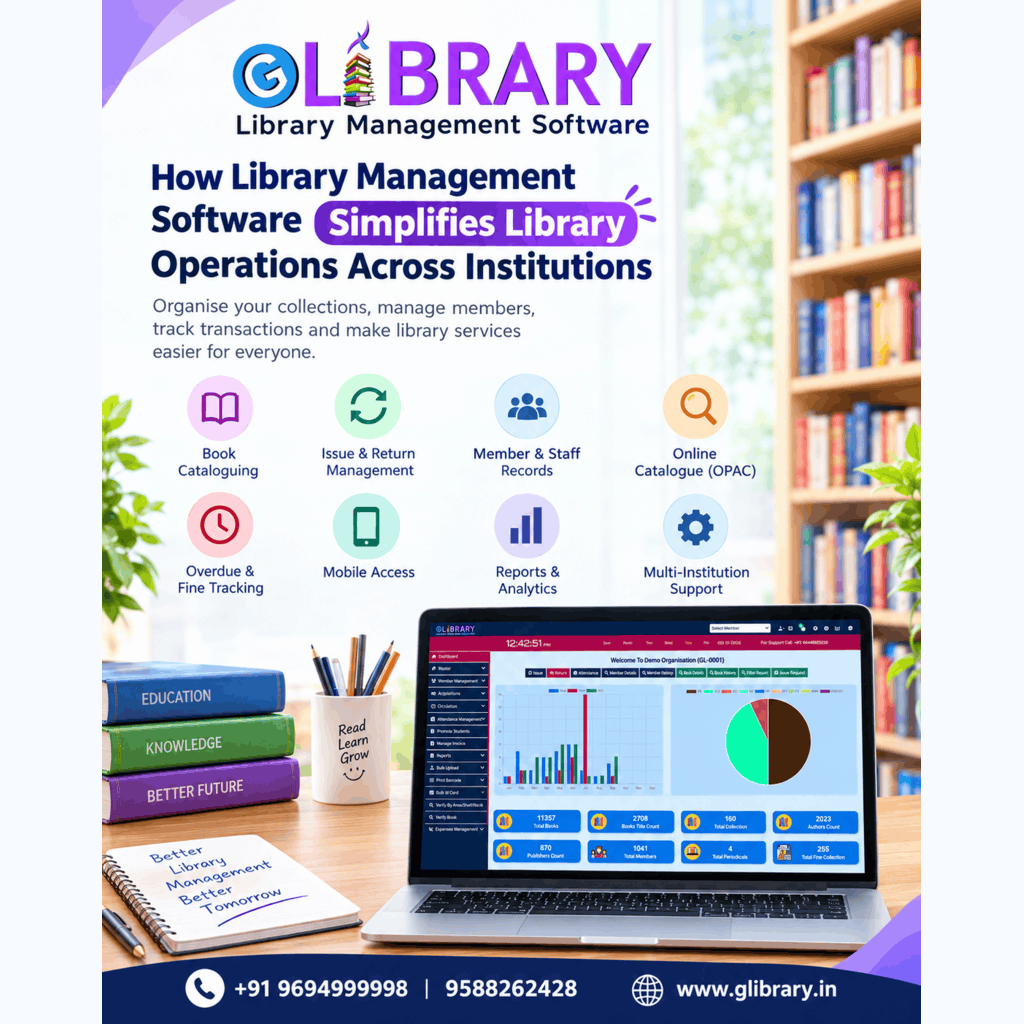
Managing a library involves much more than storing books on shelves. Library staff must organise collections, maintain book and member records, handle issue and return transactions, track overdue books, and help users find the resources they need. When these activities are managed through manual registers or scattered spreadsheets, daily operations can become time-consuming and difficult to maintain accurately. Library Management Software helps simplify these responsibilities by bringing essential library activities into a structured digital system. Schools, colleges, universities, government institutions, and private organisations can use library software to organise their collections, reduce repetitive administrative work, and make library services more accessible. With solutions such as GLibrary – Library Management Software, institutions can manage key library activities through features designed for everyday library operations.
1. Simplify Book Cataloguing and Collection Management
Maintaining accurate book records is one of the most important responsibilities of a library. As collections grow, updating registers manually can make it harder to locate titles and maintain consistent information.
- Organised book records: Maintain important information about books and other library materials in a structured digital catalogue.
- Bulk uploading: Import supported book records using Excel files to reduce repetitive data entry when adding large collections.
- Acquisition management: Record new resources and organise acquisition-related information more efficiently.
A well-maintained catalogue helps library staff manage existing collections and makes it easier to keep records updated as new resources are added.
2. Manage Book Issue and Return Transactions Efficiently
Book circulation is a routine activity across school, college, university, public, and private libraries. Manual entries can take additional time, particularly when many users borrow or return books during busy periods.
- Issue and return tracking: Maintain transaction records for books issued, reissued, and returned.
- Barcode-based operations: Use barcode generation to help identify books and support faster circulation transactions.
- Updated book status: Keep circulation records organised so staff can check the recorded status of library materials.
These processes help reduce repetitive paperwork and support more consistent handling of daily transactions.
3. Maintain Student, Member, and Staff Records
Different institutions serve different types of library users. Schools and colleges may manage student records, universities may serve students and faculty, while government and private organisations may maintain employee or general member records.
- Centralised member information: Keep member details organised within the library system.
- Bulk member uploads: Import supported member records through Excel files instead of entering every record individually.
- Multi-user access: Allow authorised staff to use the system according to assigned user rights.
A structured record-management process helps staff access relevant information more conveniently and maintain consistent library records.
4. Help Users Find Books Through an Online Catalogue
Library users often need to know whether a particular book is listed in the collection before visiting the library or asking staff for assistance. An online public access catalogue can make this process more convenient.
The Online Public Access Catalogue (OPAC) allows users to search catalogue records and find information about library materials.
- Easier discovery: Help users search the available catalogue rather than depending entirely on manual assistance.
- Better access to information: Make recorded book details easier to find.
- More independent searching: Support users who prefer to explore library resources themselves.
OPAC functionality can be useful in educational institutions, research environments, and other libraries where users regularly search for specific titles.
5. Track Overdue Books and Manage Fines
Overdue books can create additional work for library staff, especially when due dates and applicable charges are tracked manually. A digital system helps organise the records associated with these transactions.
- Overdue fine management: Use available fine-collection features to manage applicable charges for late returns.
- Member-wise records: Maintain relevant transaction and fine information against library members.
- Consistent administration: Follow the library's defined rules for overdue books and applicable fine rates.
These processes help staff maintain clearer records and reduce the effort involved in checking individual entries.
6. Support Mobile Access and Flexible Library Workflows
Library administration does not always take place at a single desk. Depending on the software's supported functionality, mobile access can help staff and members use selected library services more conveniently.
GLibrary provides mobile application access for library-related activities, along with multi-user login functionality.
- Mobile accessibility: Access supported library functions through the mobile application.
- Multiple authorised users: Allow different staff members to work within the system according to their permissions.
- Member access: Provide members with access to supported account and library services.
These capabilities can help institutions make routine library work more flexible while maintaining organised access to information.
7. Improve Reporting and Administrative Oversight
Library administrators need reliable records to understand collections, circulation activity, and day-to-day operations. Organised digital information makes it easier to review recorded activities and prepare for administrative requirements.
- Circulation information: Review available issue, reissue, and return records.
- Collection oversight: Maintain organised information about books and acquisitions.
- Fine records: Review relevant fine-related transactions.
- Administrative reporting: Use the software's available reporting features to support routine monitoring and record maintenance.
The information available will depend on the system's reporting functions and the records maintained by the institution.
8. Choose Library Management Software That Fits Your Institution
Not every library has the same requirements. A school may prioritise simple circulation and student records, while a university may need to organise a larger collection and serve different categories of users. Government departments and private organisations may have their own recordkeeping and access requirements.
Before selecting Library Management System Software, institutions should consider:
- Essential features: Check whether the software supports cataloguing, circulation, acquisitions, OPAC, barcoding, fine records, and reporting as required.
- Ease of use: Ensure that staff can learn the system and manage routine tasks comfortably.
- Data management: Understand how records are maintained, backed up, and accessed.
- User permissions: Check whether multiple users can work with appropriate access rights.
- Support and scalability: Consider the support available and whether the software can accommodate the institution's changing needs.
Selecting software according to actual requirements helps institutions avoid paying for unsuitable functionality or overlooking essential operational needs.