09
Oct
2026
How to Manage a Study Library Efficiently: A Complete Guide for Library Owners
Running a study library involves much more than providing desks and a quiet environment. Library owners need to manage seat availability, membership plans, attendance, fee collection, renewals, and daily expenses while ensuring that members have a comfortable place to study. When these activities depend entirely on registers, spreadsheets, and memory, even routine tasks can consume valuable time. An efficient study library requires clear processes, organized records, and the right tools to handle daily operations. Whether you operate a small reading room or a large study centre with multiple shifts, improving your management system can help reduce errors, save time, and create a better experience for members. This guide explains practical ways to manage a study library more efficiently.
1. Organize Seats and Study Shifts Properly
Seat management is one of the most important responsibilities of a study library owner. Members may choose different plans depending on their preferred timings, such as morning, afternoon, evening, night, or full-day access. Without a clear system, the same seat may accidentally be assigned to multiple members, while other seats remain unused. Start by creating a complete record of your seats and their availability. Assign seats according to membership plans and define shift timings clearly. Keep the information updated whenever a member joins, changes a seat, renews a plan, or leaves the library. A library management app can make this process easier by helping you view seat availability and manage shift-wise allocations in one place. This reduces the need to check multiple registers before confirming a seat and helps you understand how effectively your available space is being used.
2. Maintain Accurate Member Records
Member information should be easy to find whenever you need it. Searching through paper files for contact details, joining dates, payment history, or membership validity can slow down daily operations and increase the risk of mistakes.
Maintain a complete profile for every member. Depending on your library's process, this may include:
- Member name and contact details
- Joining date and membership plan
- Assigned seat and selected shift
- Fee payment history and renewal date
- Relevant membership status or notes
Keep these records updated whenever a member's plan, seat, or payment status changes. Organized member information also makes it easier to answer queries, follow up on renewals, and maintain consistent service. Using a digital member management system can reduce repetitive data entry and help you retrieve information quickly. It is particularly useful when your library has many members or offers several membership options.
3. Make Attendance Tracking More Reliable
Attendance helps library owners understand daily usage and maintain a record of member visits. When attendance is recorded manually, entries can be missed, handwriting may be unclear, and reviewing older records can take unnecessary time. Choose an attendance process that fits your library's size and operating style. Keep entry records consistent, review attendance regularly, and make sure staff members follow the same procedure. If your library uses biometric attendance or another supported attendance system, integrating it with your management workflow can further reduce manual work. Digital attendance records can also help you identify attendance patterns and answer practical questions, such as which members visit regularly or which shifts experience the highest usage. These insights can support better planning and more organized operations.
4. Improve Fee Collection and Renewal Management
Fee collection requires careful tracking of paid amounts, pending payments, membership expiry dates, and renewals. If payment details are scattered across notebooks, messages, and separate files, it becomes difficult to know which members have outstanding dues. Maintain a clear payment record for each member and update it as soon as a payment is received. Establish a consistent renewal process and inform members before their plans expire. Where appropriate, use automated SMS or WhatsApp reminders to reduce repeated follow-ups and help members remember upcoming payments. A digital payment history also makes it easier to review collections over a selected period. Instead of calculating every figure manually at the end of the month, library owners can use organized records and collection reports to understand their financial position more clearly.
5. Monitor Expenses and Daily Collections
A library may collect membership fees regularly and still struggle to understand its actual financial performance if expenses are not recorded properly. Rent, electricity, internet, maintenance, furniture, and staff costs can all affect profitability. Record expenses consistently and categorize them so you can compare costs over time. Review daily collections alongside monthly expenses rather than looking at income alone. This helps you identify rising costs, plan future spending, and make more informed decisions about membership pricing. Collection reports and expense management tools can simplify this process by keeping important financial information organized. Accurate records are also useful when preparing monthly summaries or reviewing the performance of your study library.
6. Term & condition on Invoice
A well-managed study library needs clear and consistent rules. Members should understand the timings of their chosen shift, seat usage policies, payment deadlines, noise expectations, and procedures for changing or renewing a plan. Display the rules where members can easily see them and explain important conditions during registration. Apply policies consistently so that members understand what to expect. Clear communication can reduce misunderstandings about seats, timings, payments, and shared facilities. It is equally important to handle enquiries professionally. Keep track of prospective members, respond to questions promptly, and follow up when appropriate. An organized enquiry process can help convert interested visitors into registered members.
7. Use Reports to Make Better Decisions
Daily management becomes easier when decisions are based on accurate information rather than assumptions. Reviewing seat occupancy, membership renewals, attendance, collections, and expenses can reveal where your library is performing well and where improvements may be needed. For example, if a particular shift has many vacant seats, you could review its timings or membership pricing. If renewals frequently happen late, you may need an earlier reminder process. If expenses increase every month, a categorized report can help you identify the main causes. Make time to review important reports regularly. Even a short weekly review can help you spot recurring issues before they become bigger operational problems.
8. Simplify Daily Operations with a Library Management App
Once your library grows, managing every activity manually can become increasingly difficult. A library management application brings essential tasks into a more organized workflow, helping owners manage seats, shifts, members, attendance, payments, reminders, and reports without relying on separate records for everything. When selecting an application, look for features that match your actual requirements. Consider ease of use, member and seat management, shift scheduling, attendance options, payment tracking, reporting, customer support, and data security. Choose a solution that can support your current operations while accommodating future growth.
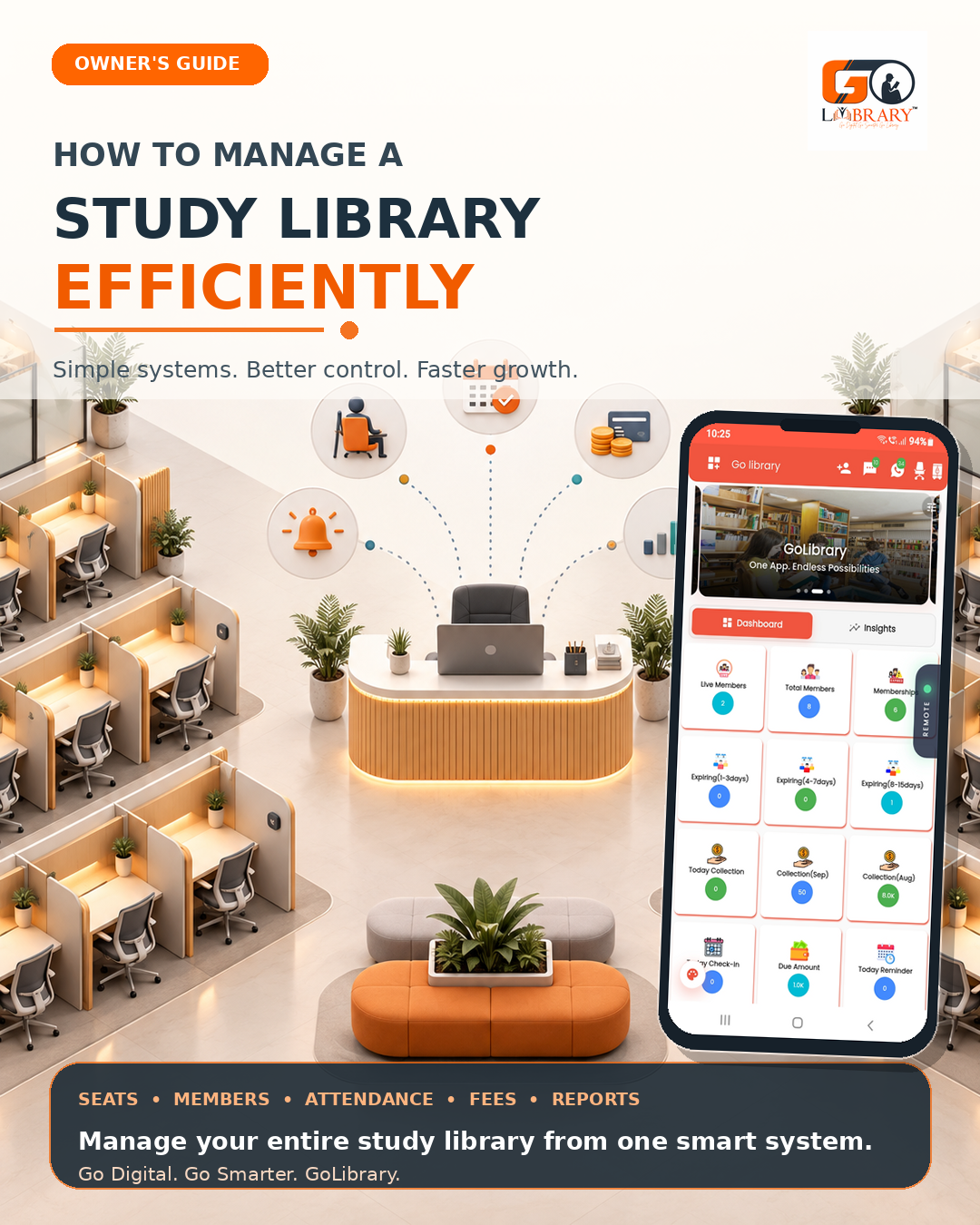
GO Library helps study library owners organize important daily activities through features such as Seat Management, Shift Management, Member Management, Attendance Management, Auto SMS and WhatsApp reminders, Collection Reports, Expense Management, Enquiry Management, and Branch Management. Its AI-powered insights can also help owners understand their library operations more clearly. By bringing these activities into one platform, GO Library can help reduce repetitive administrative work and make everyday management more convenient. Explore the features at www.golibrary.in to see whether they fit your library's needs.
Frequently Asked Questions
How can I manage a study library efficiently?
Start by organizing seat allocations, maintaining accurate member records, tracking attendance, monitoring payments, and recording expenses. Establish clear rules and review reports regularly. A library management app can help bring these activities together and reduce manual work.
Which tasks should a study library owner track daily?
Important daily tasks include checking seat availability, recording attendance, updating member details, tracking fee collections, responding to enquiries, and noting expenses. The exact routine will depend on the size and operating hours of your library.
Why is seat and shift management important?
Proper seat and shift management helps prevent double allocation, makes availability easier to check, and supports better use of the library's capacity. It also helps owners organize membership plans around different study timings.
Can a library management app reduce paperwork?
Yes. A suitable application can digitize member records, seat assignments, attendance, payment histories, reminders, and reports. The amount of paperwork reduced depends on the features used and how consistently the system is maintained.
What should I look for in a library management application?
Look for practical features such as seat and shift management, member records, attendance tracking, fee reminders, collection reports, expense management, data security, and responsive customer support. Select an application based on your library's actual needs and budget.
Managing a study library efficiently starts with organized processes and reliable information. Better seat planning, accurate member records, consistent attendance tracking, timely fee reminders, and regular financial reviews can make daily operations more predictable and manageable. As your library grows, digital tools can help you handle these responsibilities with less repetitive work. By choosing the right processes and a suitable library management app, you can spend less time managing paperwork and more time improving the study environment and growing your library business. GO Library offers a range of management features designed to support these everyday needs.