20
Nov
2026
QR vs. Biometric Attendance for Study Libraries: Which Setup Fits Your Branch?
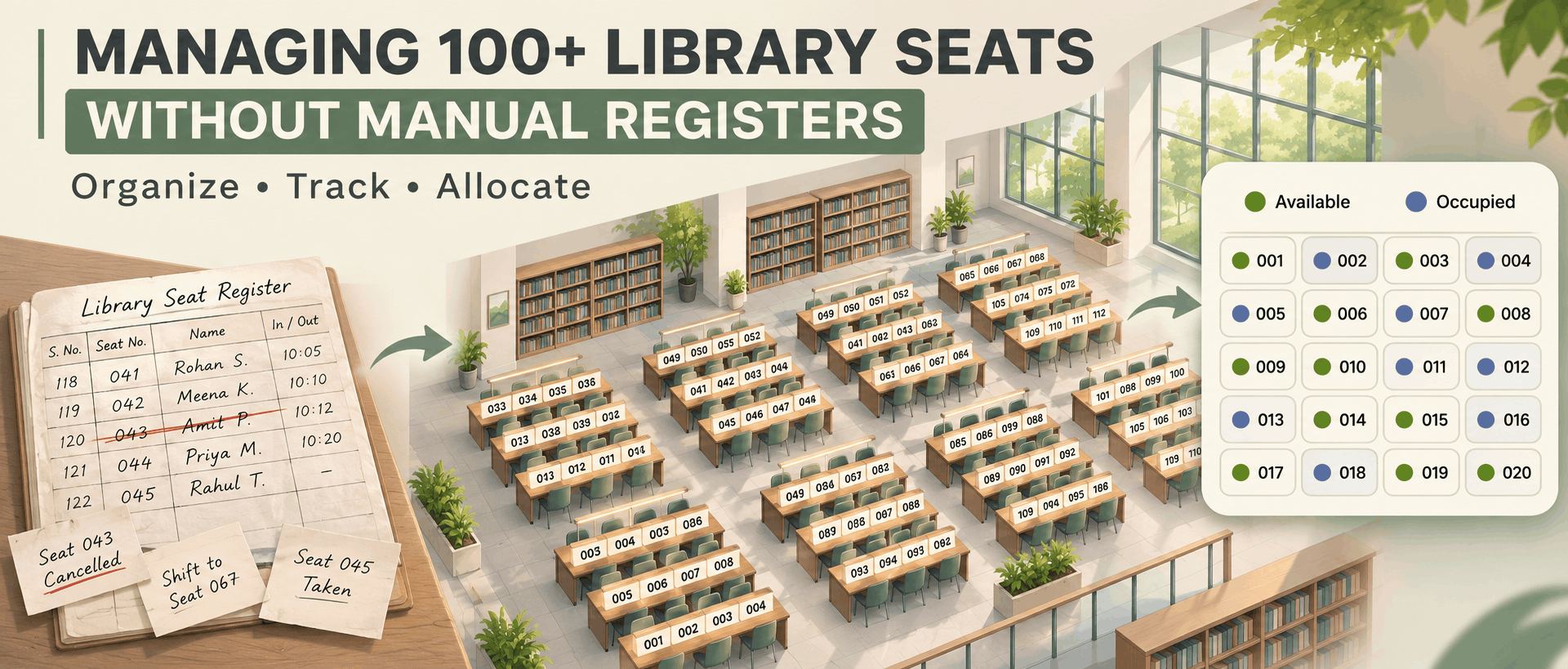
Managing attendance is an important part of running a study library or reading room. Library owners need to know when students enter and leave, maintain accurate attendance records, and ensure that membership access is properly monitored. Traditionally, attendance was recorded using registers or manual entry systems. However, as study libraries become more organized and technology-driven, QR code and biometric attendance systems are becoming popular alternatives.
But which option is better for your study library: QR-based attendance or biometric attendance?
Both systems help automate attendance tracking, but they work differently and offer different advantages. Understanding their features, costs, convenience, and limitations can help you choose the right setup for your library branch.
Why Is Automated Attendance Important for Study Libraries?
Study libraries and reading rooms often operate in multiple shifts, including morning, afternoon, evening, and night. Some libraries also have hundreds of students visiting throughout the day.
Managing attendance manually can create several challenges:
- Time-consuming attendance recording.
- Incorrect or duplicate attendance entries.
- Difficulty tracking student entry and exit times.
- Problems monitoring multiple shifts.
- Difficulty maintaining attendance records.
- Additional administrative workload.
An Automated Library Management Application can simplify these activities by maintaining digital attendance records and connecting attendance information with student membership details.
Let's understand how QR and biometric attendance systems work.
1. QR Code Attendance System: How Does It Work?
A QR-based attendance system uses Quick Response (QR) codes to record student attendance.
Each registered student receives a unique QR code associated with their membership or identification details. When students enter the library, they scan their QR code using a supported mobile device or scanning setup.
The system records the attendance information digitally.
Benefits of QR Code Attendance
1. Quick Check-In
Students can scan their QR codes to mark attendance without manually entering their details. This makes the entry process faster and more convenient.
2. Easy Implementation
QR-based attendance generally requires less specialized hardware than biometric systems. Depending on the setup, an existing smartphone or QR scanner may be sufficient.
3. Cost-Effective Setup
For small study libraries or newly established reading rooms, QR attendance can be a budget-friendly option because it may not require dedicated biometric devices.
4. Digital Attendance Records
Attendance information can be maintained digitally through a Library Management Web Application or supported mobile platform, making it easier for administrators to review student attendance history.
5. Convenient for Multiple Branches
For library owners managing multiple branches, QR-based attendance can provide a consistent check-in process across different locations when connected to a centralized system.
Limitations of QR Code Attendance
Despite its advantages, QR attendance also has some limitations:
- Students may share their QR codes with other people.
- Screenshots or copied QR codes may create misuse risks if additional verification is not implemented.
- A smartphone or scanner is required for scanning.
- Internet connectivity may be necessary, depending on the attendance system.
- Poor lighting or damaged QR codes can sometimes affect scanning.
A well-designed Library Manager App should consider these limitations and provide suitable verification measures.
2. Biometric Attendance System: How Does It Work?
A biometric attendance system identifies individuals using unique physical characteristics, such as fingerprints or facial features.
Students register their biometric information during membership enrollment. When they enter the library, they use the supported biometric device to verify their identity and record attendance.
This reduces dependence on physical cards, printed QR codes, or manually entered identification details.
Benefits of Biometric Attendance
1. Better Identity Verification
Biometric systems use individual physical characteristics to verify student identity, making attendance manipulation through shared QR codes more difficult.
2. No Physical QR Code Required
Students do not need to carry a separate membership card or remember to open an application to scan a code.
3. Automated Attendance Tracking
The system records attendance after successful biometric verification, reducing manual work for library administrators.
4. Improved Attendance Accountability
Biometric verification can help reduce proxy attendance and improve confidence in attendance records.
5. Useful for High-Traffic Libraries
Large study libraries with hundreds of daily visitors may benefit from biometric verification when the devices are properly configured and capable of handling the expected traffic.
Limitations of Biometric Attendance
Biometric systems also have certain challenges:
- Initial hardware and installation costs can be higher.
- Fingerprint scanners may sometimes fail due to dirty, wet, or worn fingerprints.
- Facial recognition performance can vary with lighting and device quality.
- Device maintenance and technical support may be required.
- Biometric information requires careful privacy and security protection.
Before implementing biometric attendance, library owners should establish clear consent, access controls, retention policies, and secure handling procedures for biometric data.
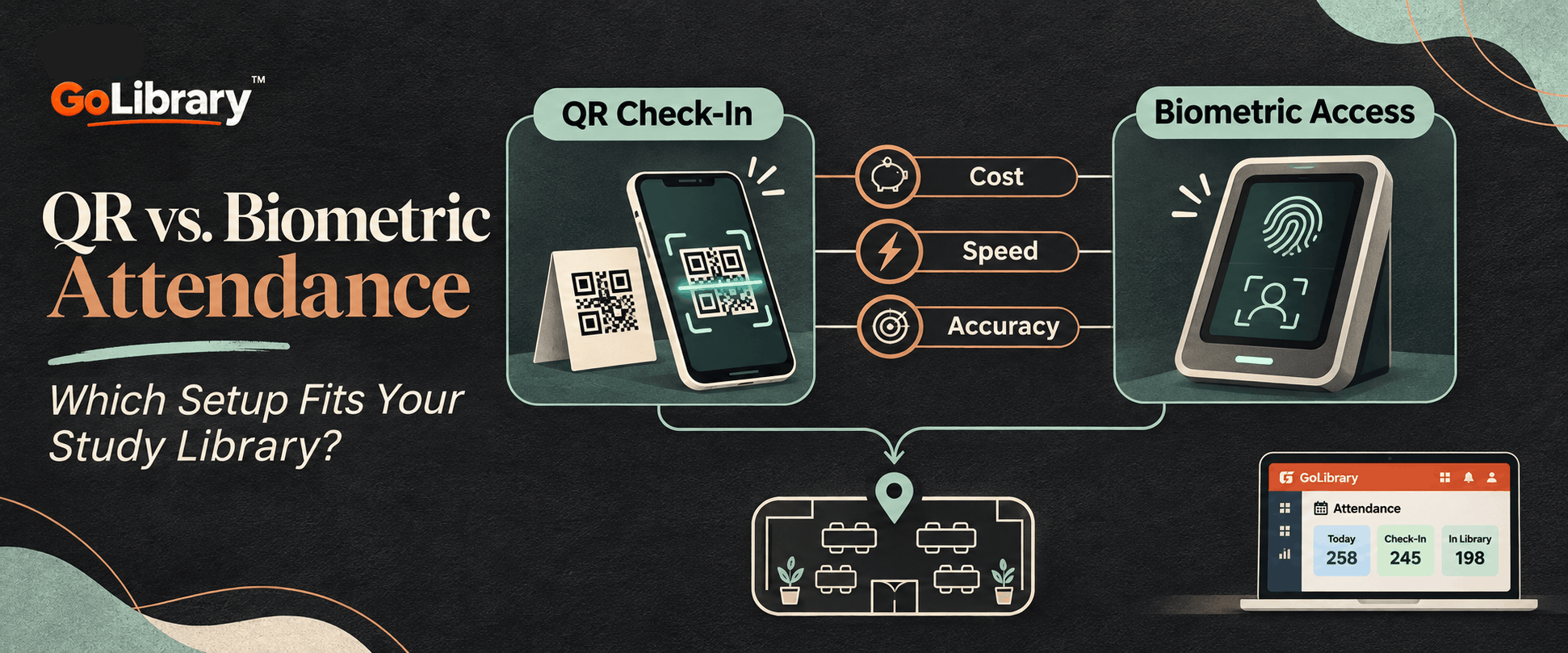
3. QR vs. Biometric Attendance: Key Differences
Both attendance systems can automate student check-ins, but their suitability depends on the size, budget, and operational requirements of your study library.
| Comparison | QR Attendance | Biometric Attendance |
|---|---|---|
| Identification | QR code scanning | Fingerprint or facial verification |
| Hardware | Smartphone or QR scanner | Biometric device |
| Initial investment | Generally lower | Generally higher |
| Check-in process | Scan QR code | Verify biometric identity |
| Proxy attendance risk | Higher without additional verification | Generally lower |
| Maintenance | Relatively simple | Device maintenance required |
| Privacy considerations | QR and account data protection | Additional biometric data protection |
| Best suited for | Small and medium libraries | High-traffic libraries |
The right choice depends on your operational needs rather than simply selecting the more advanced technology.
4. Which Attendance System Is Better for Different Library Branches?
Not every study library has the same requirements. A small reading room with 50 students may not need the same attendance infrastructure as a large study center with 500 members.
Here are some practical considerations.
Small Study Libraries
For small reading rooms with limited membership and a controlled entry process, QR attendance can be a practical choice.
It offers a relatively simple implementation process and helps reduce manual attendance work without requiring significant hardware investment.
Medium-Sized Study Libraries
Libraries with multiple shifts and a growing student base can consider either system.
The decision should depend on daily visitor volume, available budget, student convenience, and the level of identity verification required.
A Seat Management App combined with digital attendance records can also help administrators monitor occupied seats and student allocations more efficiently.
Large Study Libraries
Large reading rooms with high daily traffic may benefit from biometric attendance systems.
Biometric verification can improve identity checks, particularly when many students enter during peak hours. However, administrators should also consider device capacity, entry queues, backup arrangements, and maintenance requirements.
Multi-Branch Study Libraries
For owners managing several branches, consistency is important.
A centralized Library Administration Application or Modern Library Management Application can help standardize attendance procedures, membership records, shift management, and reporting across locations.
Whether QR or biometric technology is selected, the attendance system should work reliably with the library's overall management process.
5. What Should You Consider Before Choosing an Attendance System?
Before investing in either setup, evaluate these important factors:
- Branch Size: Consider the number of registered students and daily visitors.
- Budget: Compare hardware, installation, maintenance, and software costs.
- Student Convenience: Choose a system that students can use easily.
- Attendance Accuracy: Decide how much identity verification your library requires.
- Internet Connectivity: Check whether the system supports your available network conditions.
- Data Security: Ensure that student information and attendance records are protected.
- Software Compatibility: Check whether the attendance hardware integrates with your existing Library Management Mobile Application or other management platform.
- Future Expansion: Consider whether the setup can support additional seats, students, shifts, and branches.
A reliable Library Management App should make attendance management easier while supporting other essential activities such as membership management, fee collection, shift allocation, and seat tracking.
QR and biometric attendance systems both offer practical solutions for modern study libraries and reading rooms. QR attendance is generally affordable, simple to implement, and convenient for smaller libraries. Biometric attendance offers stronger identity verification and can be suitable for larger libraries with higher attendance volumes. There is no universal winner. The best option depends on your branch size, budget, student requirements, infrastructure, and privacy considerations.
Choosing the right Library Management Application alongside an appropriate attendance setup can help reduce administrative workload, improve attendance accuracy, and make daily library operations more organized. Ultimately, the goal is not simply to replace a manual attendance register with technology. It is to create a smoother, more reliable, and better-managed study library environment.